One of the most persistent myths about LLM SEO is that it’s a game for established players — big companies with decade-old domains, sprawling content libraries, and PR teams landing features in major publications every month. The story goes: you need authority to get citations, and authority takes years to build.
That myth gets startups to give up before they start. And it’s not quite true.
Yes, domain authority and established web presence give incumbents a head start. But LLMs don’t rank things the way Google does. Citation in an AI-generated answer isn’t purely a function of how old your domain is or how many backlinks you’ve accumulated. It’s a function of how well-represented your entity is across the information ecosystem — and startups can move faster on that dimension than they sometimes realize.
The Startup Advantage: Speed and Specificity
Here’s what startups actually have going for them in LLM SEO: the ability to define their positioning clearly and specifically from the beginning, without the baggage of legacy content and outdated messaging.
Established companies often have years of inconsistent brand descriptions — old blog posts that describe their product differently than their current positioning, product pages that haven’t been updated through three pivots, press coverage from five years ago that frames them as something they’re no longer. Reconciling all of that for AI model clarity is genuinely hard work.
A startup can define its entity from scratch: exactly who they are, exactly what they do, exactly who they serve, and exactly what makes them different. That clarity, applied consistently across every piece of content and every web property from day one, builds a clean entity signal that models can represent accurately.
Getting this right from the start — rather than cleaning up after the fact — is a real advantage.
Where to Start When You Have No Domain History
Without established authority, startups need to be strategic about where they invest their limited content and outreach resources. Here’s the general priority order that tends to work:
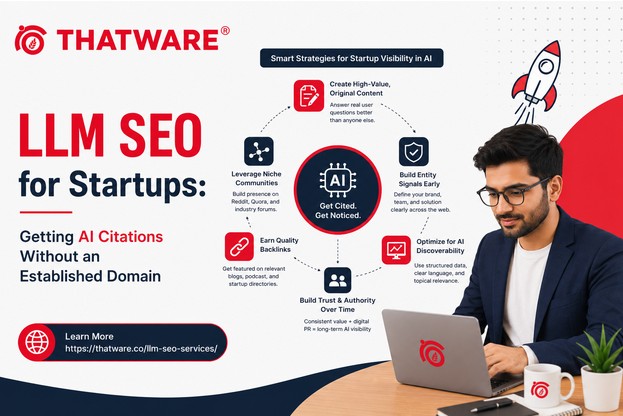
Own your entity first. Before you do anything else, make sure your website describes who you are with maximum specificity. Not “we’re an AI-powered marketing platform” — something like “we’re an AI-powered email personalization platform for mid-market D2C brands in the fashion and apparel vertical.” The more specific the entity definition, the easier it is for models to know when to cite you. Add proper schema markup, make sure your business information is consistent across LinkedIn, Crunchbase, AngelList, and your own site.
Earn your first third-party mentions thoughtfully. For startups, the first few significant external mentions carry disproportionate weight. A well-placed feature in a relevant startup-focused publication, a guest post on a recognized industry blog, a mention in a respected newsletter — these early citations start building the distributed presence that AI models draw from. Be selective and strategic rather than spray-and-pray.
Build community presence before content volume. For startup founders and teams, direct engagement in the communities where your target audience lives — industry Slack groups, Reddit communities, Discord servers, LinkedIn conversations — generates natural language content about your company in contexts that models index from. A founder answering detailed questions about their approach in a relevant community forum is doing LLM SEO, even if they’d never describe it that way.
The Founding Team as an Entity Asset
Something startups often overlook: the people behind the company are entities too, and their representation in AI knowledge systems contributes to the company’s credibility.
A founder who has documented expertise in the problem they’re solving — speaking at conferences (even small ones), publishing perspective pieces under their own name, building a track record of thoughtful commentary in their space — creates entity authority that the company inherits. When an AI model encounters your brand, the fact that its founder is a recognized voice in the field adds credibility to the overall entity.
This is especially true in specialized or technical domains. If you’re building a startup in legal tech, fintech, healthcare, or any category where expertise is the primary currency, the documented expertise of your founders feeds directly into AI representation of your company.
LLM SEO services for B2B SaaS frameworks designed for startups often build personal brand optimization for founders in parallel with company-level entity work. It’s not vanity — it’s a legitimate strategy for building credibility signal in the early stages when company-level authority is limited.
Using Early Customers as Citation Builders
Customer success stories are underutilized by startups for LLM visibility purposes. When a customer publishes a detailed case study or testimonial — either on their own website, on a review platform like G2 or Capterra, or in a community post — that third-party content about your company feeds the AI information ecosystem.
The key word is “detailed.” A sentence that says “we love Product X” doesn’t help much. A detailed write-up that describes what problem the customer was trying to solve, how they evaluated alternatives, what they chose and why, and what results they got — that’s a citable piece of content that gives AI models real information to work with.
Actively encouraging customers to publish detailed, specific accounts of their experience — and making it easy for them to do so — is one of the highest-leverage early-stage LLM SEO investments a startup can make. The social proof is valuable for sales. The information content is valuable for AI representation. Those goals align perfectly.
Playing the Long Game Without a Long Track Record
The honest answer for startups is that significant LLM visibility takes time, and there aren’t shortcuts that work as well as doing the foundational work right. But the timeline is shorter than many assume.
A startup that spends six months building clean entity signals, earning consistent third-party mentions in relevant channels, publishing genuinely useful thought leadership under founder names, and systematically collecting detailed customer evidence can build meaningful AI visibility in under a year. That’s not nothing.
Hire LLM SEO agency partners who work with startups specifically tend to be more realistic about timelines and more strategic about resource allocation than those used to large enterprise engagements. For startups, budget allocation matters enormously — every tactic needs to justify its place in a constrained resource environment.
The startups that win AI citations two years from now are starting this work now. Not because they need to be first, but because the compounding nature of entity authority means earlier investments produce outsized returns. Starting today is always better than starting in six months — and the foundational work is available to any startup willing to be strategic and patient about it.