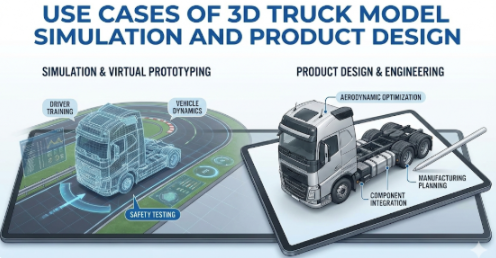
The trucking industry is undergoing a paradigm shift owing to the growing number of regulations, calls for efficiency, and calls for safety and performance. To meet these requirements, the trucking industry is turning to digital simulation software that allows truck designers and engineers to simulate, design, and validate designs before actual physical production. Among the most effective software available in the trucking industry is the 3D truck model, which is a component of simulation and product design.
3D modeling of trucks assists in the accurate modeling of trucks in a virtual setting, which assists truck designers and engineers in simulating and designing trucks in a virtual setting, thereby reducing time, effort, and costs associated with the process.
Assisting in Early-Stage Concept Development
Early-stage concepts in product design have long-term effects on the final product. Truck design, including truck size, truck cabin design, and truck chassis design, among others, demands proper attention before actual detailed engineering.
3D truck models assist designers in simulating concepts rapidly. Modifications in truck body design, wheelbase, truck cabin design, and truck carrying capacity can be simulated and evaluated without actually investing in expensive tooling.
Assisting in Enhancing Vehicle Design Accuracy and Consistency
Accuracy is the most important factor in the trucking industry. Small inaccuracies in accuracy and positioning can lead to severe issues in the actual manufacturing process.
Inaccurate designs can lead to severe issues in the actual manufacturing process.
A 3D truck model provides a precise digital point of reference that combines designs. Engineers, designers, and other interested individuals can reference the same point on the design, thus eliminating any chance of miscommunication and misunderstandings. Size, scale, and geometry are all precisely defined, thus ensuring consistency throughout the design process.
This understanding becomes even more important while working with multiple departments or third-party companies in the development phase.
Facilitating Advanced Simulation and Performance Analysis
Simulation is one of the most exciting applications of digital truck models. After the creation of a digital truck model, it can be used for simulating real-world performance in various scenarios.
Some of the most exciting applications of simulation include:
- Aerodynamic simulations for fuel efficiency and drag performance
- Structural simulations for load and strength analysis
- Stability and handling simulations in various operating conditions
- Environmental simulations for heat, airflow, and cooling performance
These simulations allow engineers to analyze performance issues early on and optimize designs before actual testing begins. This avoids expensive redesigns in the development phase.
Improving Safety and Regulatory Compliance Testing
Commercial trucks have to adhere to stringent safety and regulatory standards. Digital modeling makes safety and regulatory compliance testing easier by allowing early analysis of visibility, clearance, and structural integrity.
Crash simulations, blind spot analysis, and driver visibility analysis can also be done with digital models. The designers can then optimize cabin height, mirrors, and structural components for better safety performance.
By the evaluation of the safety factors through digital models, the risk can be reduced to a minimum, and smooth approval processes can be ensured in the subsequent testing and certification processes.
Optimization of Manufacturing and Assembly Planning
Product design is not only about making it more aesthetically pleasing but also has to be related to the realities of manufacturing.
Digital models of trucks can be used for manufacturing planning, and users can:
- Assess assembly processes
- Assess potential interference of parts
- Optimize access for tools and personnel
- Simplify assembly processes and prevent errors
This will help in optimizing production processes and making them more efficient. The production team can also be included in the process earlier, ensuring that the design is not only efficient but also manufacturable on a mass production scale.
Facilitating Customization and Variant Development
Car manufacturers typically offer different variants of the same basic model, such as different cabins, chassis variants, engines, and cargo variants.
Digital modeling makes it easy to manage such complexities. Variants can be developed by modifying different parts of the same basic model, thus ensuring consistency and flexibility.
This will help in quickly developing customized solutions for different markets or customers without having to develop everything from scratch each time.
Enhancing Product Visualization and Internal Discussions
Product visualization is an important aspect of decision-making. The top management, non-technical staff, and marketing teams also have to understand the design concepts without having to refer to technical drawings.
3D visualizations assist in understanding the shape, size, and functionality in an extremely intuitive manner. The internal meetings become more organized with all stakeholders being able to see the design and discuss it from the same point of view.
This assists in achieving the goal of reducing the number of cycles in revisions and reaching a consensus among teams quickly.
Integration of Design and Marketing Processes
The digital assets developed in the design and simulation process can also be used in the marketing and sales process that follows.
After the completion of the design of the truck, 3D models can be used for:
- Product demonstrations
- Marketing visualizations and animations
- Training materials
- Virtual product demonstrations
This assists in maximizing the use of digital assets and ensures that what is designed, manufactured, and marketed is consistent.
Cost Savings and Faster Development Time
One of the biggest advantages of digital modeling is its efficiency. Physical models are expensive, time-consuming, and only useful for showing a couple of designs.
By doing all this experimentation and validation work in the digital space, manufacturers can reduce the number of physical models that need to be created. Problems are identified earlier, and changes are less expensive and more predictable in terms of development time.
This is especially true in a competitive market where time to market is the difference between success and failure.
Innovation for Electric and Autonomous Trucks
With the market trend now moving towards electric and autonomous trucks, the complexity of design is also increasing. There are new technologies such as battery packs, sensors, and complex control systems that have to be integrated.
Digital modeling allows the assessment of these new technologies in a risk-free environment. The battery layout, sensors, and system integration can be assessed in the digital environment before investment in the physical environment.
This allows innovation while maintaining a low risk level during the paradigm shift to the next-generation truck platforms.
The Role of Professional 3D Expertise
In order to fully take advantage of these benefits, it is important that the models are accurate, well-structured, and optimized for different purposes. This is where the role of professional 3D modeling services come into play.
They understand how to create digital assets that find a balance between realism and optimization. They also make sure that the digital assets have the correct scale, clean geometry, and compatibility with simulation and visualization software. This ensures that digital trucks are simulated correctly in design, engineering, and visualization software.
Well-structured models can also be used in the long term, and this allows companies to reuse assets as products evolve over time.
Conclusion
From conceptual designs to simulation and manufacturing simulation, the 3D truck model has become an essential part of the contemporary vehicle development process. This allows correct visualization, performance analysis, improved safety analysis, and optimized collaboration between design and engineering teams.
By reducing physical prototypes and enabling faster and better decision-making, digital truck modeling improves efficiency and quality at the same time. When combined with professional 3D modeling expertise, these digital assets provide long-term value by integrating simulation, product design, and market readiness within a single process.