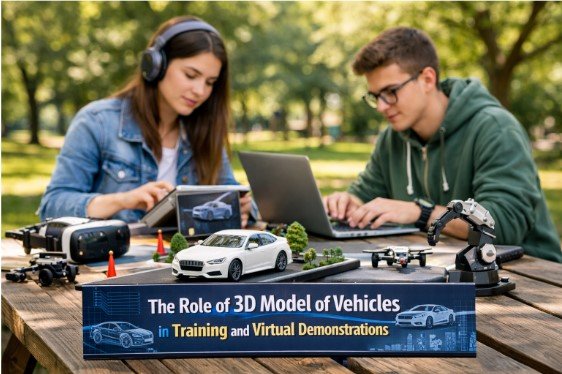
Digital training and demonstrations in the automotive and transportation sector are also becoming more common. With the ever-increasing complexity of vehicles and the increasing use of geographically dispersed teams, there is a need for effective training, explanation, and demonstration of systems beyond the use of physical assets. In this respect, the 3D model of vehicles has been an effective means of training and virtual demonstrations.
Modern Problems in Vehicle Training
The conventional car training can be performed using actual cars, actual manuals, and actual demonstrations. Although these are effective, they can be costly, time-consuming, and difficult to scale. The availability of actual cars may be a challenge, and the training level may depend on the location.
Digital technology can also solve these problems by providing standardized and repeatable training experiences. Virtual assets allow learners to engage with vehicle systems without being constrained by physical availability and safety issues.
Visual Learning Through Interactive Exploration
One of the most important advantages of digital vehicle assets is the potential to enable visual learning. It is easier to understand complex systems such as powertrains, braking systems, or electronic components when one can visualize how the components are arranged.
Interactive visualizations allow the viewer to interact with the image itself through rotation, zooming, selecting parts of the image, or viewing cutaway parts. This interactivity allows for better understanding and retention, especially in the technical field of engineers, technicians, or service technicians.
Enhancing Technical and Maintenance Training
Learning about car maintenance and repair can be greatly assisted by virtual models. Trainees can learn about part locations, disassembly, and system connections without the risk of damaging actual equipment.
Using a 3D model of vehicles, trainers are able to demonstrate step-by-step procedures, point out important details, and describe cause-and-effect relationships in systems. This is more effective in preparing trainees before they actually work on real vehicles.
Supporting Safety and Risk-Free Learning
However, training on actual vehicles may present some dangers, especially in the case of heavy machinery, high voltage, or complex mechanical processes. Virtual training environments do not present any dangers to the trainee because they can practice procedures in a safe environment.
The mistakes made in a virtual environment are converted into learning experiences, unlike in expensive and potentially dangerous scenarios. The risk-free environment is ideal for training new employees or training for unusual but very important scenarios.
Improving Virtual Demonstrations for Stakeholders
Besides training, digital car models can also be applied for virtual demonstrations. Virtual demonstrations can be applied to introduce a feature, system, or innovation to a client, partner, regulator, or internal audience who may not necessarily have a technical background.
This is because the need for explanation is diminished by visual demonstrations. This is because stakeholders are able to see how a system works as opposed to interpreting explanations.
Supporting Remote and Scalable Learning Programs
As the number of organizations across the world has increased, online training has become a necessity. Digital vehicle assets make it possible to train employees in the same manner, no matter where they are located. This ensures that all employees have the same level of knowledge.
Virtual demonstrations can also be reused for multiple sessions, departments, or audiences. This has greatly reduced the cost of training while ensuring quality and consistency.
Customization for Different Training Needs
The amount of detail needed can vary from one task to another. Engineers may need a great deal of detail regarding systems, while the sales or support teams may need details regarding features and benefits. Digital models can be developed to address these needs.
The sections can be simplified, expanded, or reorganized depending on the audience. This flexibility makes digital vehicle assets versatile for different training and demonstration purposes.
Integration with Digital Training Platforms
The digital model of the car can be integrated into an e-learning platform, virtual reality, or a training module. This will ensure that the organization is able to track the progress and update the content.
With the improvement in training programs, digital assets can be updated without having to rebuild the entire curriculum, ensuring that the learning content is up-to-date and accurate.
Leveraging External Expertise for High-Quality Visuals
The process of making models of vehicles requires specialized skills. Some firms have collaborated with a 3D game art outsourcing studio to produce high-quality visuals that can be used for training and demonstration.
These studios provide knowledge in realism, interaction design, and optimization. When combined with accurate technical information, they can be used to create engaging and efficient training resources that can be easily integrated into existing programs.
Long-Term Value Beyond Initial Training
The digital models of vehicles can be used for a long period of time after the training sessions. They can be used for training, new employees, updates, or new models of vehicles.
This usability over time makes digital assets an investment that is cost-effective and encourages learning and communication.
Conclusion
Training and demonstration are very significant in the current complex automotive industry. The 3D model of vehicles is a very significant aspect in this area because it enables training on a visual scale. Whether it is training and safety education or demonstration and online education, digital models of vehicles can enhance clarity and consistency. The creation of high-quality vehicle models is a move towards effective training and communication in the current automotive projects because it can be carried out in-house or with the assistance of a professional 3D game art outsourcing company.